CASE /// CARE SERVICES

Diakoniestation Marbach
Live clientLIVE CLIENT · CARE SERVICES · DIAKONIESTATION-MARBACH.DE
One leadership post that decided how large the station was allowed to be.
The one post that capped how large the station was allowed to be — filled.
Four hires, the nursing management among them; 16 ads, the strongest at €0.54 per click across 20,922 accounts reached.
The return here is not a revenue figure, it is permission: without that regulated leadership role the station was not allowed to grow, no matter how much demand there was.
“A project without a clear ROI is not an investment. It is an expense.”
Where they stood
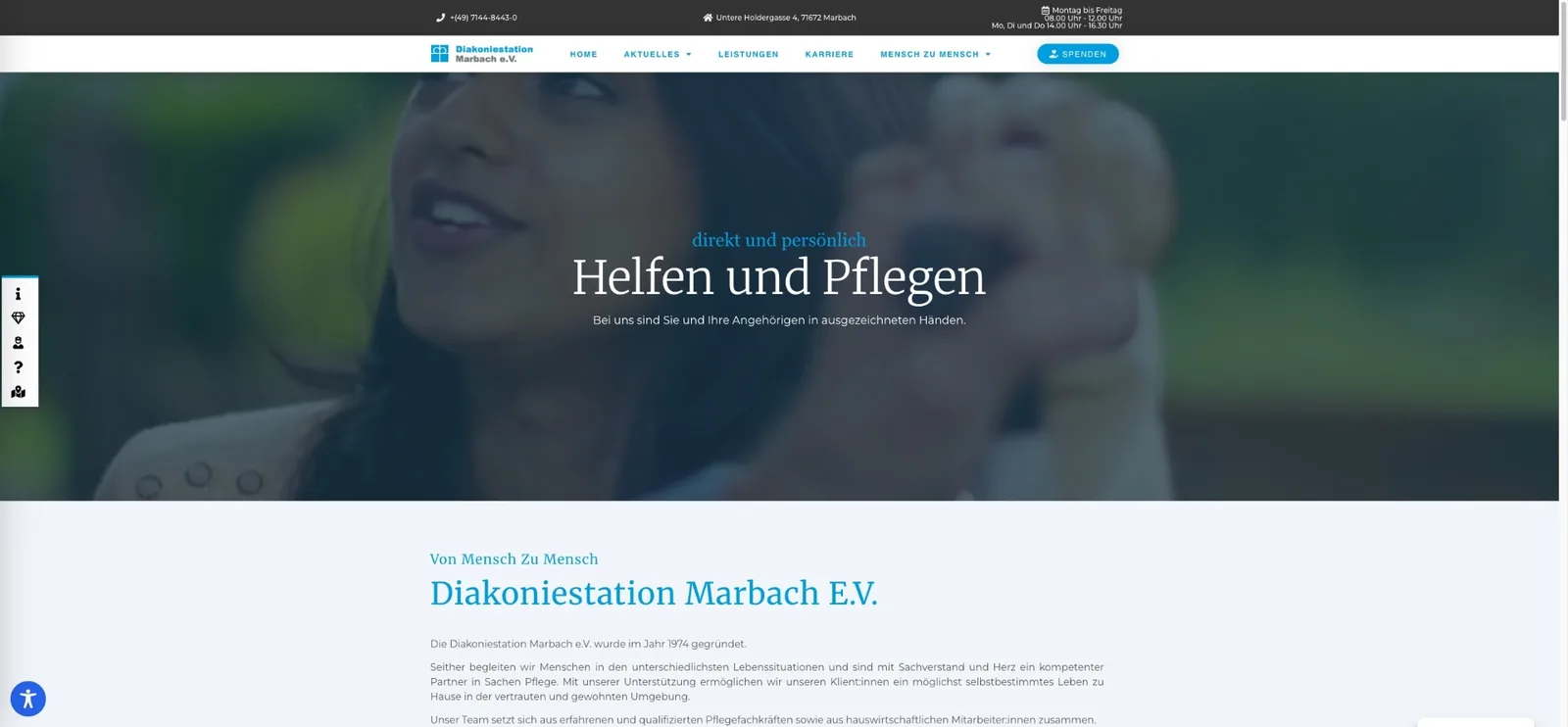
A Diakonie care station, and a client of ours for around six years. The website came first: a new site, built so that donating directly would finally be simple. Recruiting came later, when they came to us with a problem that had nothing to do with marketing.
What the real problem was
A leadership post in care is not an ordinary vacancy. It is a ceiling.
The role is regulated: a qualified nurse, in a substantial permanent position, with several hundred hours of additional leadership training on top — and a deputy is mandatory. The required leadership capacity scales with the size of the service, and the detailed rules differ from state to state.
In practice that means two things. A station cannot simply grow past its own leadership. And you cannot promote someone into the role on Monday, however willing they are.
So the question was never “how do we advertise this job”. It was: how does a care station outcompete every other employer in the region for a very small group of people who are all already employed elsewhere.
The decision — and why
We ran it the way we run customer acquisition, because it is the same discipline: you sell the position the way you sell a product.
What the role actually offers, to whom, in their language — and then a process that treats the applicant like a lead worth keeping rather than a file to be processed.
That part is independent of industry. What changes between a workshop and a care station is the argument, not the method.
What it became
View it liveOne position, one funnel
Applying took sixty seconds, with no CV and no cover letter, because a nurse with a leadership qualification is employed and will not write a cover letter for a maybe.
Each role got its own advert and its own funnel. That is not a detail. Put four roles on one ad and applicants cannot tell which job they are applying for — the replies arrive mixed up, and interest drops, because nobody is sure the advert is talking to them. We break that rule only when a client insists, and the second video here is one of those exceptions.
The ads as they ran, on Facebook and Instagram. Sound off — they were built to work muted, because that is how they were watched.
What it did for the business
Four people were hired through this, the leadership post among them. Ann-Kathrin Benneweg puts what that meant more plainly than we would: without them, the station would have gone a very different way.
What the campaign did
The donation button we built has, as far as anyone can tell, never been used except by me. Our best guess is that donations here come mostly from an older generation who still prefer a paper transfer, and that habit will not be changed by a better button. We built it, it works, and it did not solve the thing everyone assumed it would.
And the larger one: we no longer take on recruiting in nursing. This project worked, and it worked after the pandemic — so it is not that the method stopped working. What changed is the pool. In the interviews I have run since, I have met fifteen to twenty people who left care and will not return at any price, and after what that profession was put through I do not find that surprising.
A recruiting system can shorten the path to the people who are still there. It cannot bring back the ones who have gone. We would rather say that than sell a campaign into a market we no longer believe we can win.